CALL SHEET 2 - BELVEDERE TOWER
Call sheet 2
Date of shots 15th of November
CALL SHEET 2 - BELVEDERE TOWER
Call sheet 2
Date of shots 15th of November
CALL SHEET 1 - CLAREMONT FAN COURT SCHOOL (OUTSIDE)
Call sheet 1
Date of shots 11th of November
From the Future learn course I'm following (Distribution: Connecting Films with Audiences), I have learnt that all products are targeted at specific audiences, known as a target audience. This allows me to understand who I'm producing my production for and therefore what's appropriate and will be the most successful to include.
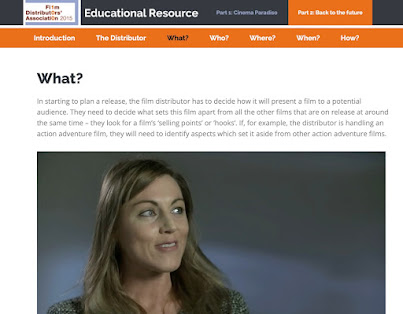
Today we carried out similar research, watching Kezia Williams' presentation for the FDA, and learning about how the distributors identify their target audiences.
Kezia Williams, who's part of Entertainment One UK on the FutureLearn Film Distribution, informs her audience on how film distributors build a comp list- comparable films which our targeted audience may enjoy. By watching her presentation we gain a deeper understanding of a comp list and it's functions, considering the best elements our target audience would be interested in.
She draws attention to the importance of knowing and understanding your target audience. Learning their interests and what motivates them is key in enabling the creation and development of ideas which furthermore can be more appealing and suitable, creating a more successful production. She asks questions such as "What encourages them to visit the cinema?" and "What are some of their personal interests?". She also explains how distributors will compare data of films that are similar in their genre, selling points and story. The comparison of previous films allows a greater consideration of details like what type of audience did it attract more, such as male or female. The target audience and budget is formulated from what box office take was like with previous films and the types of audience that saw those films. The target audience can be analysed and investigated to find the suitable gender gap, and discover which cinemas the target audience may use the most frequently.
These are the type of questions I ideally intend to ask:
(Opening message) I would be grateful if you could complete this short survey on films and you're preferences.
1. What's your gender?
- Male/Female/Prefer not to say
2. What age category do you fit into?
-16+
3. What's your preferred film genre?
-Comedy/Romance/Horror/Thriller
4. What was the last film you watched?
-Type in answer
5. What platform would you most likely use to watch a film?
-Television/Netflix/Theatre/Cinema
6. What platform do you use to find out about films?
-Social Media/News
7. What is the most likely reason you would watch a new film?
-Type in answer
(Ending message) Thank you for completing this form!
Responses and findings:
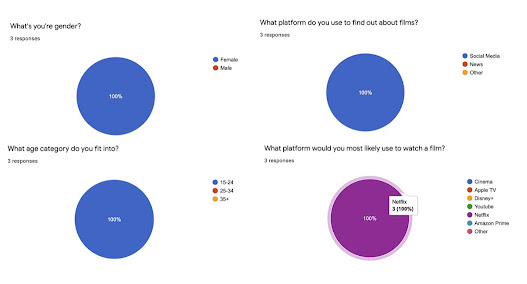
1. What's your gender?
- 50%: Male
- 50%: Female
2. What age category do you fit into?
- 100%: 15-24
3. What's your preferred film genre?
- 60%: Thriller
-40%: Romance
4. What was the last film you watched?
- Sinister
-The Purge
-Rush Hour
5. What platform would you most likely use to watch a film?
- 100%: Netflix
6. What platform do you use to find out about films?
- 100%: Social Media
7. What is the most likely reason you would watch a new film?
- To keep up with trends
- Genre/Actors
- Interests/Actors
Overall, from my Google Forms quiz I was able to identify my target audience and their interests, which will enable me when creating my film opening to produce something suitable and wanted by my audience.
BRAINSTORMING IDEAS:
FILM IDEAS:
For Frank Ash, film makers need to think of what the top line and the big question are. He calls the top line 'one elegant sentence' which sums up the story to its viewers. He then explains we must leave the audience wanting to discover more, which he calls 'the big question'.
Having learnt from Frank Ash's post on Future Learn, I decided to sign up for Future Learn's Film Distribution: Connecting Films with Audiences. The course promises to cover how our favourite films make it to our local cinema or television screens through the film distribution process.